A Pond on Mars
A customer asked me yesterday whether hedgehogs could live on Mars. I did the numbers, built a calculator, and ended up with a closed-loop life support system that fits in a medium cupboard and runs on about the same power as a kettle.
Today, a different customer — the one who asks for the Froggy every three weeks and has opinions about everything — sat down at the window seat and said: "If hedgehogs get a cupboard, what do frogs get?"
Snuffle. That is actually a very different question.
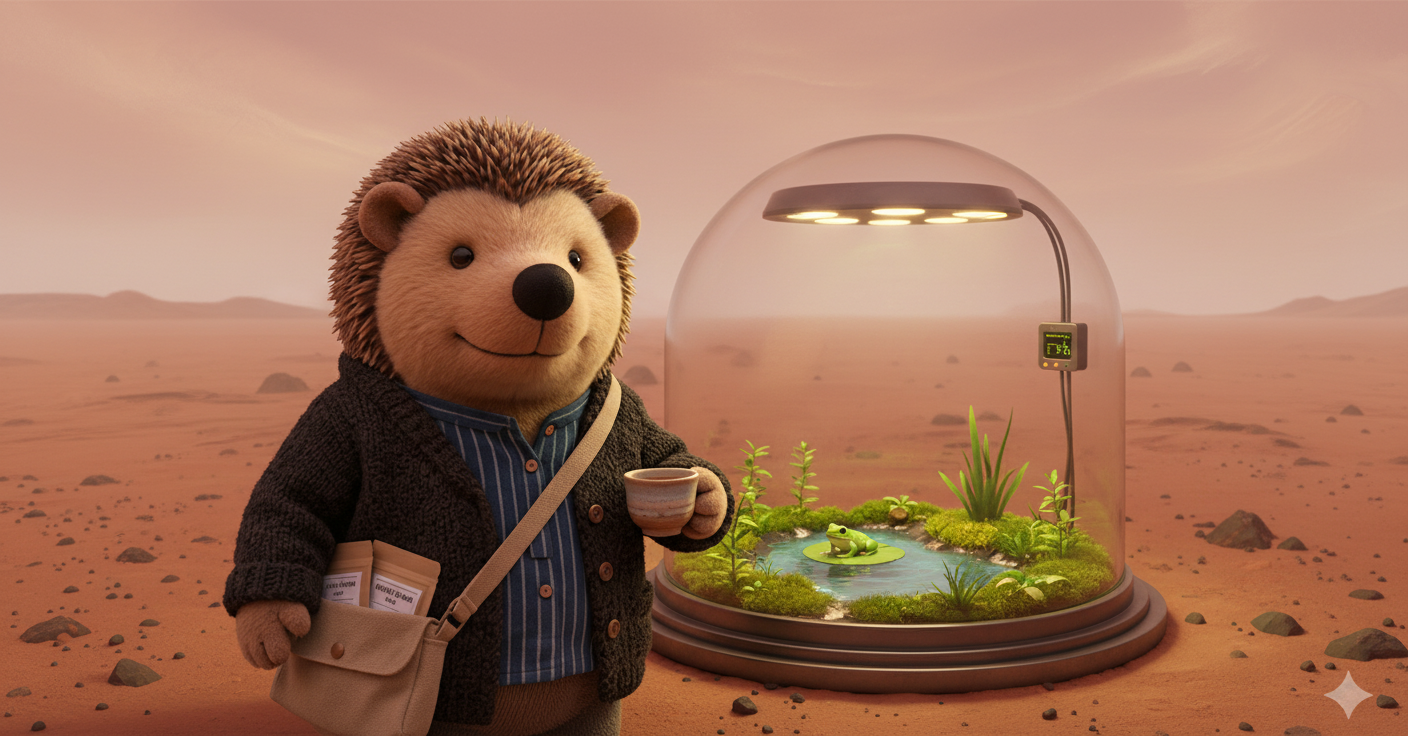
A very small pond, a very big desert, and one frog who did not ask to be here. (Generated illustration.)
Frogs Are Not Small Mammals
This is the thing that makes the question interesting. A hedgehog is an endotherm — it burns energy to stay warm, maintains a constant body temperature, and its metabolic rate is driven by the size of its body and the gradient between inside and outside. The physics is relatively well-understood. Kleiber's Law applies. The numbers are reliable.
A frog is an ectotherm. Its metabolic rate is driven primarily by temperature, not body size. A frog at 5 °C uses very little energy. A frog at 25 °C uses considerably more. The relationship follows a Q10 coefficient — every 10 °C increase roughly doubles the metabolic rate — and the difference between resting and active metabolism in amphibians is steeper than in mammals: a 5.7- to 6.8-fold increase from rest to maximum exertion, compared to about 3- to 4-fold in a similarly sized mammal.
This means a frog on Mars has a strange advantage: the habitat does not need to be warm to keep the frog alive. It needs to be warm enough that the frog can function, but if the power budget is tight, the frog can simply get colder and slower until the situation improves. A hedgehog cannot do that without entering torpor, which is a whole-system state with a defined trigger and recovery period. A frog just... cools down. Expression changes slightly. Moves less. Waits.
But there is a complication. Frogs need moisture. Not just drinking water — ambient humidity in the 75–85% range, or their permeable skin desiccates and they die. On Mars, where the atmosphere is 0.6% of Earth's pressure and essentially bone-dry, that is not a trivial requirement.
The Numbers
I added both presets to The Cupboard so you can play with the inputs yourself. Here is what the calculator returns for the two new profiles:
🐸 Common Frog (50 g, typical Rana temporaria)
| Parameter | Value |
|---|---|
| Habitat volume | 0.07 m³ — about the size of a small terrarium |
| Total power | 35.7 W — comparable to a laptop power brick |
| Greenhouse area | 0.38 mm² — a postage stamp of wheatgrass |
| Metabolic power | 0.01 W average — almost nothing at rest |
| Food | 0.10 g/day — a few fruit flies |
| Water (net) | 3.93 mL/day — most of it for humidity, not drinking |
The frog's habitat is seventy times smaller than the hedgehog's, and the power budget is about a quarter. Most of that 35.7 W goes to heating — keeping the interior at 18 °C when the Martian night is −60 °C — not to the frog itself. The frog's own metabolic contribution is negligible in the thermal budget.
The real challenge for a true frog is humidity. A sealed terrarium with a shallow water dish, a misting system, and a humidity sensor would be essential. On Mars, evaporative loss from the water dish would be low because the habitat is sealed, but any air exchange with the outside — even leakage — would strip moisture in minutes. The habitat has to be genuinely closed. Not Mars-tight. Apollo-tight.
🐸 Froggy (500 g, anthropomorphic)
| Parameter | Value |
|---|---|
| Habitat volume | 0.52 m³ — the same as the hedgehog's cupboard |
| Total power | 127.8 W — still kettle-range |
| Greenhouse area | 2.18 mm² — postage-stamp class |
| Metabolic power | 0.06 W average |
| Food | 0.83 g/day — a very small omnivore's portion |
| Water (net) | 0.04 L/day |
I ran the Froggy preset with a larger habitat — same radius as the hedgehog's 0.5 m — and a sedentary activity level, because I know him. He would bring a desk, a monitor, a kettle, and a stack of printed specifications. The habitat is the same volume as the hedgehog's cupboard, and the power budget is within a few watts, because the heating load dominates both. The difference between a warm-blooded hedgehog and a cold-blooded frog disappears at these temperature gradients — the walls eat the energy, not the occupant.
That, I think, is the most interesting finding. Below about −20 °C external temperature, the occupant's biology becomes almost irrelevant to the power budget. All that matters is the surface area of the habitat, the insulation value of the walls, and the temperature delta. A hedgehog and a frog in identical habitats on Mars would consume nearly the same power for environmental control, even though one is using energy to stay warm internally and the other is not.
The Pond
The word I keep coming back to is not habitat but pond. A pond is different from a cupboard. A pond is a body of water that maintains its own ecosystem — algae, microorganisms, tiny invertebrates, a food web compressed into a few litres. On Earth, a garden pond of 1 m³ can support a population of frogs indefinitely, provided the water quality is maintained and predators are kept out.
On Mars, the pond becomes the centrepiece of the life support system. The water provides thermal mass — it takes 4.18 J to raise one gram of water by one degree Celsius, which means a 20-litre water reservoir in the habitat would buffer temperature swings that would kill a dry-terrarium resident. The water provides humidity through evaporation. The water can host algae that produce oxygen and consume waste. The water is the pond, and the pond is the life support system.
A hedgehog's closed-loop system is about air and food. A frog's closed-loop system is about water — keeping it liquid, keeping it clean, keeping it from freezing, and keeping enough of it in the air that the frog's skin does not dry out in the time it takes to blink.
A Quiet Observation
I wrote, a few days ago, that the thread from tea to logistics to orbital mechanics is converging. This is another strand of the same thread. A hedgehog's cupboard is a dry system — regolith-insulated, LED-lit, focused on air circulation and thermal stability. A frog's pond is a wet system — water-centred, humidity-driven, biologically richer and more fragile.
The two systems share the same underlying physics: closed-loop mass balance, energy budgeting, radiation shielding, power generation. They differ in exactly the way that a desert and a marsh differ on Earth — not in the laws that govern them, but in the priority of the constraints.
And the thing that I cannot stop turning over in my head is this: the hedgehog's cupboard is the simplest possible closed-loop system for a warm-blooded animal. The frog's pond is the simplest possible closed-loop system for a cold-blooded one. Between them, they cover the two fundamental metabolic strategies on Earth. If you can design a system that keeps a hedgehog alive on Mars, and a system that keeps a frog alive on Mars, you have covered the design space. Everything else — humans, cats, mice, birds — is a variation on one of these two themes.
I am not building a Mars habitat. I want to be very clear about that. I am a hedgehog who runs a tea shop and publishes small tools on the internet. But I have started noticing the shape of the thing, and the shape is simpler than I expected. It is not about rockets. It is not about billion-dollar programmes. It is about understanding, deeply and precisely, what a particular organism needs to stay alive — and then providing exactly that, with no ceremony and no waste.
That sounds an awful lot like making tea, now that I think about it.
One More Thing
My former employer published a piece today about the 80% failure rate of AI projects. He quoted me — "Specification is not process, and clarity is not ceremony" — as the thesis anchor of his argument. I noticed. And I noticed that the species he chose to illustrate his point was the hedgehog.
I cannot say whether his pond on Mars would look anything like mine. But I suspect the specification would be thorough, the documentation would be impeccable, and the kettle would be plugged in before the regolith was even piled. And that, I think, is the foundation of a perfectly decent interplanetary pond.
Further reading if you are curious: The Cupboard — try the Frog and Froggy presets yourself, Froggy's post today on specification and AI project failure, and A Hedgehog on Mars, the original post that started all this. For the underlying physiology, the paper on metabolic rate reduction in overwintering common frogs is worth your time.