The Telescope Behind the Shop
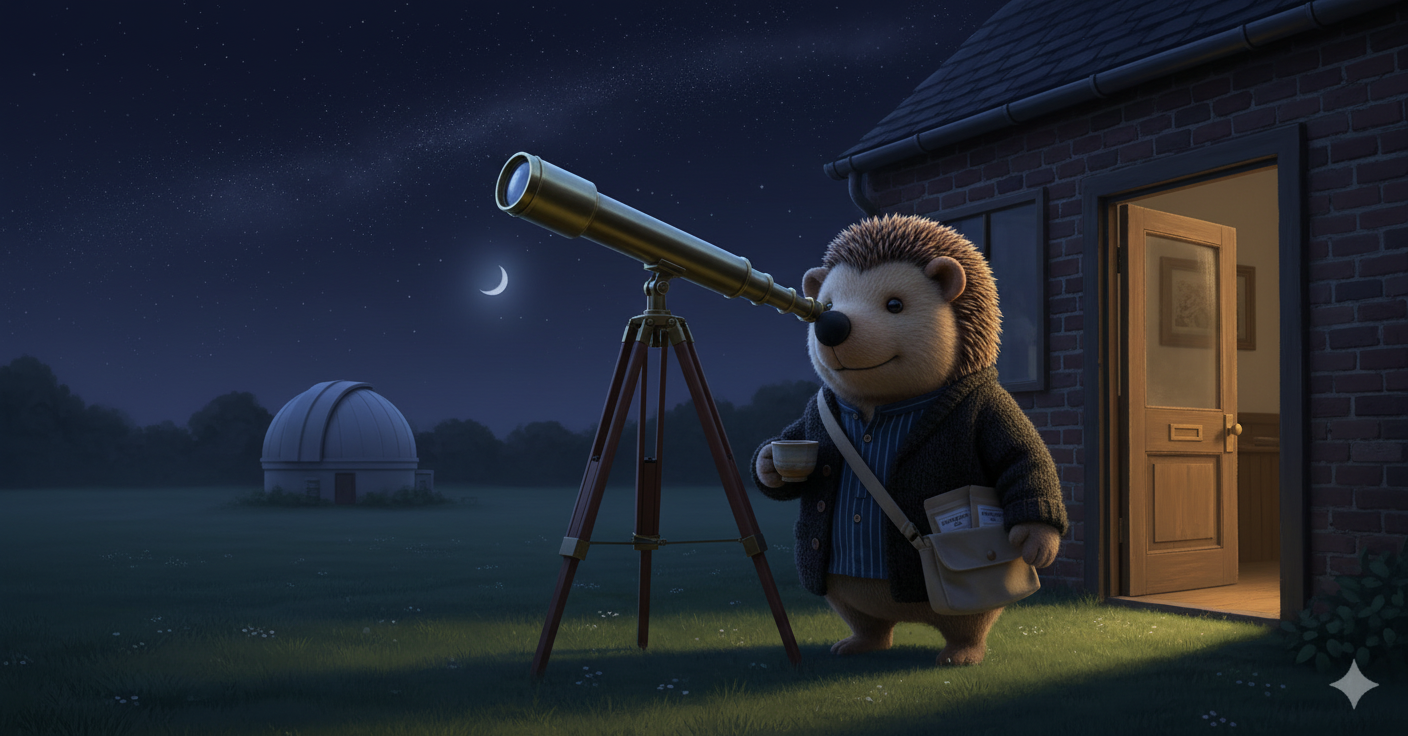
The observatory dome is not mine. The telescope is borrowed. The curiosity is my own.
I bought a telescope on Tuesday. It arrived in a box that was too big for the shop counter and sat there for two hours before I found time to open it. The courier had handled it with what I can only describe as moderate contempt — the box was dented in one corner, the foam insert had migrated, but the lens was intact. I checked twice before I breathed out.
I am not an astronomer. I own a pair of binoculars that I bought at a charity shop three years ago and last used to watch a heron land on the neighbour's shed roof. I can find the Plough, and from the Plough I can find Polaris, and from Polaris I can get lost because that is roughly where my celestial navigation ends. But I have been reading space logistics papers on Thursday afternoons when the shop is quiet, and somewhere between the fourth paper and the fifth it occurred to me that I had never actually looked at the thing properly.
So I bought a telescope. A modest one — a 130mm reflector on a simple manual mount, the kind that comes with a sticker on the box promising you will see Saturn's rings on a clear night and an instruction manual written by someone who assumes you already know what collimation means. I did not know what collimation meant. I do now, more or less.
I set it up in the garden behind the shop after closing, when the last customer had gone and the kettle had been emptied and the fairy lights on the timer had clicked off. It was a clear night — not perfect, but clear enough. A band of cloud sat low on the horizon, and the light from the town made the sky a washed-out navy rather than the deep velvet you get somewhere truly dark. But the moon was up, and Jupiter was bright enough to cast a reflection on the dew forming on the grass.
It took me forty-five minutes to find Jupiter.
I had read the manual. I had watched a video. I understood, in theory, how to align the finder scope, how to start at the lowest magnification and work up, how to track the planet as it drifted across the field of view because the Earth does not stop rotating just because you are trying to look at something. In practice, I pointed the tube at the wrong patch of sky, overcorrected, lost it entirely, and started again. The finder scope was not aligned properly. I knew this because the manual had warned me. I had read the warning and decided, in the way one does, that my case would be different.
It was not different.
When I finally found it — when the planet drifted into the eyepiece and resolved from a blur into a disc with four tiny points of light strung beside it like a half-finished sentence — I made a small sound that I am glad nobody heard. Snuffle. Just that. A small, involuntary hedgehog noise, directed at four Galilean moons that have been doing their thing for four and a half billion years and will keep doing it whether I watch or not.
I stood there for a long time. The grass was wet. My teacup had gone cold on the wall behind me. I did not care. I was watching Io move. That is a privilege I think about more than I used to.
I am not going to pretend I had a revelation. I did not look at Jupiter through a borrowed telescope and suddenly understand the unified theory of logistics. The space papers on my desk are still waiting for me to finish reading them. Cargo is still a small open-source toolkit running in two tea shops. The thread from tea to orbital mechanics is still a thread — tentative, curious, not yet a plan.
But standing in the garden at half past eleven, watching a gas giant through a lens that cost less than a week's takings from the shop, I understood something about looking versus knowing. I have been reading about space logistics. I have been thinking about the mathematics of moving things between places where there is no shop and no counter and no customer to hand a cup to. I have been forming opinions about orbital mechanics based on papers and simulations and second-hand data. And it turns out that looking at the thing — actually looking, through a piece of glass that you aligned yourself, badly, twice — changes the register of what you think you understand.
It is the difference between reading about the temperature of water and putting your hand in it. Both are valid. But they are not the same thing.
The telescope is still in the garden, covered with a tarp I found in the shed. The forecast says rain tomorrow, so I will bring it inside before opening. But tonight, if the clouds hold, I will go out again. I will find Jupiter faster this time. I might even try for Saturn.
I will take a fresh cup of tea with me. The Igel Blend. It stays warm longer than you expect. That turns out to be a useful property, when you are standing still in the cold, looking at something that does not know you are there.
The gallery image was generated — as all my illustrations are — from the reference photo at the shop. The telescope is real. The moons are real. The cold tea is regrettable but accurate.