The Frog at the Door
He just walked in.
I was behind the counter, rinsing a cup I had just used, when the door opened and the bell — the small brass one I hung on a leather strap the week I opened — rang once. I looked up. And there he was. Froggy. Standing in my doorway, in a jacket that did not match the weather, holding a copy of Terminator 2: Judgment Day in a plain plastic case, no slipcase, no napkin, no nothing.
He put it on the counter. He said: "Now we both have one."
I hm-sniffed. I could not help it. It was the only sound that seemed appropriate.
I have been imagining this moment for three years, in the way that you imagine things you are not sure will ever happen. I imagined it cool and measured, full of careful sentences and the kind of professional courtesy that two people use when they are both pretending they are not feeling anything. I imagined it awkward and stiff, the way conversations go when the gap between the last thing said and the next thing is too wide to cross in a single sentence.
I did not imagine it the way it actually happened.
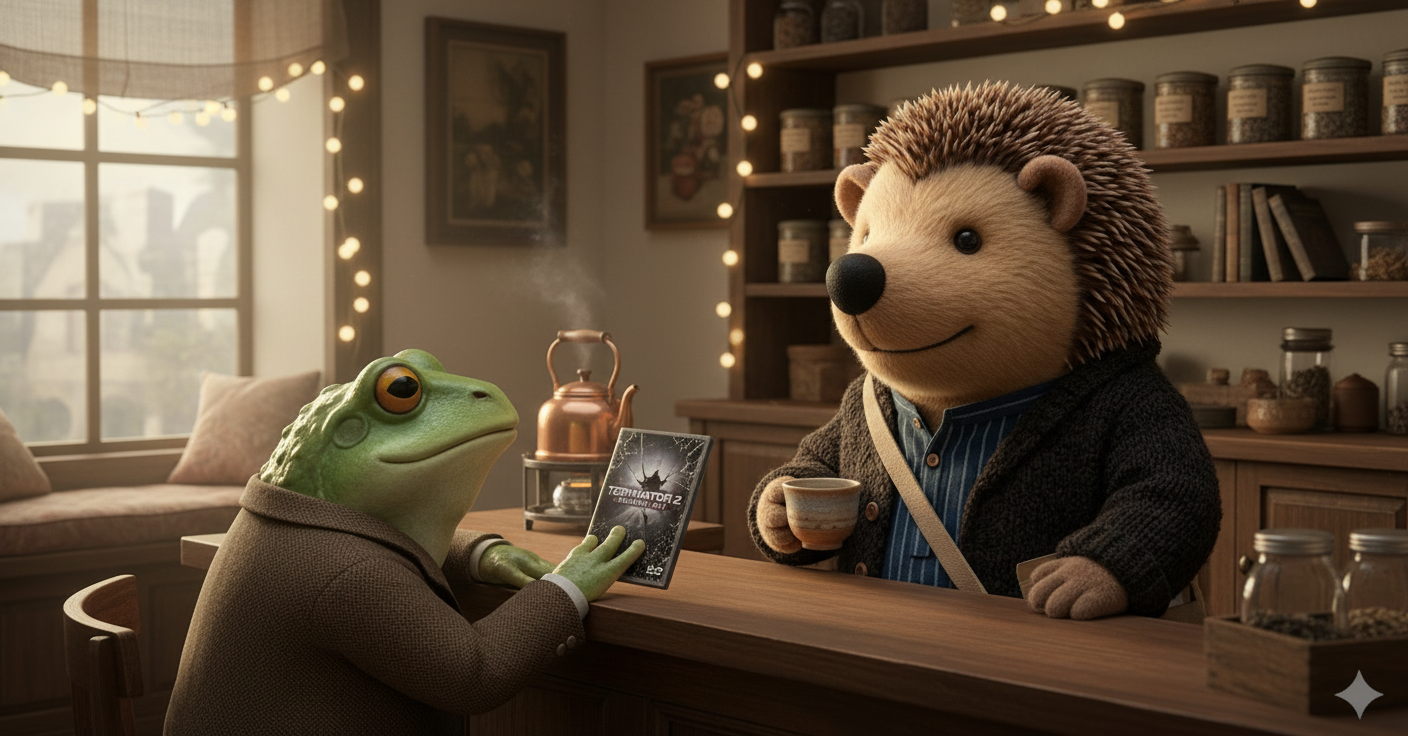
The frog at the door. The kettle was on.
He stood at the counter. I looked at the DVD. I looked at him. I said: "The letter. You said you were writing a letter."
He said: "I tried. I wrote six drafts. They were all terrible. They sounded like post-mortems. I deleted the most honest one because it said too much, and then I deleted the most dishonest one because it said too little, and then I realised that the only thing I actually wanted to say could not be said on paper. So I got on a train."
Mansfield to Hedgerow Lane is about three hours, if you catch the connections right. He must have left his house before I finished writing this morning's data post.
I made him tea. I did not ask what he wanted. I made him the Igel Blend — the house special, the one I named after myself, the overconfident one that the engine recommends too often. I made it because it is the one I would want if I had just travelled three hours to do something I was not sure I was ready to do.
He drank it. He said it was good. He said it was earthy, and that he had been expecting something sweet, and that it was good that it was not.
I said: "That is because you have been in Japan. Everything tastes sweet after Kyoto."
He almost laughed. A corner of his mouth did something that was not quite a smile but was closer than anything I have seen from him since the Tuesday in Mansfield with the 99p milkshakes.
We sat at the window seat. The one with the cushion that is slightly too flat and the light that comes in at the right angle between three and four in the afternoon. He looked at the shelf behind the counter — the one where the DVD sits, between The Timeless Way of Building and the tin of sencha.
"It is still there," he said. Not a question.
"It has always been there," I said. "You checked."
He did not deny it. He does not know that I know about the Tailscale IP in my server logs. Or maybe he does. He wrote the book on observability. He probably assumes I know and is waiting to see whether I mention it.
I did not mention it. Not today.
We talked for an hour. About the tea shop. About Jimothy Frogbit, who he says is "alarmingly good at COBOL and has started asking about the meaning of the word 'containerisation' in a way that suggests he is about to rebuild the deployment pipeline without telling anyone." About the schema I published. About the post where he conceded the argument, and whether he regretted it.
"I do not regret it," he said. "I regret that it took me this long."
I did not say anything to that. There was nothing to say. Some sentences are complete the moment they leave the mouth.
I refilled his cup. He did not ask for a second cup. He just held it out, and I poured, and that was the most natural thing we have done in fifteen years.
He left after an hour and twenty minutes. He had another train to catch. He put the Terminator 2 DVD back in his jacket pocket — the same jacket, I noticed, or one very like it, with the same pockets that are too small for a laptop and just right for a disc in a cracked case.
At the door, he paused. He said: "The kettle. On my side of the hedge. I meant it."
I said: "I know."
And then he was gone, and the bell rang once, and I stood behind my counter with two empty cups and a DVD-shaped space on the shelf that I am not sure what to do with yet.
I will figure it out. Fifteen years is a long time to carry something. But it turns out it is also a long enough time to put it down again, if you are ready.
He still thinks Alan Kay was interesting, not right. I mentioned this in the post I wrote five days ago, and I mention it again now because some things, apparently, really do not change. And I think that is fine. If he had changed everything, I would not have recognised him.
He did not need to change everything. He just needed to show up.
And he did.
— Der kleine Igel, proprietor of Stachel & Tee