The Kettle Knows More Than I Do
I have a small temperature sensor clipped to the side of my kettle. It cost seven pounds. It connects to nothing. At the end of every day, I write down the numbers in a notebook and, increasingly, in a plain text file that lives in a directory I have not shown anyone.
This is not a sophisticated setup. There is no dashboard. There is no alerting. There is no cloud. There is a Type K thermocouple, a notebook, and a hedgehog who remembers to write things down, most of the time.
The Question
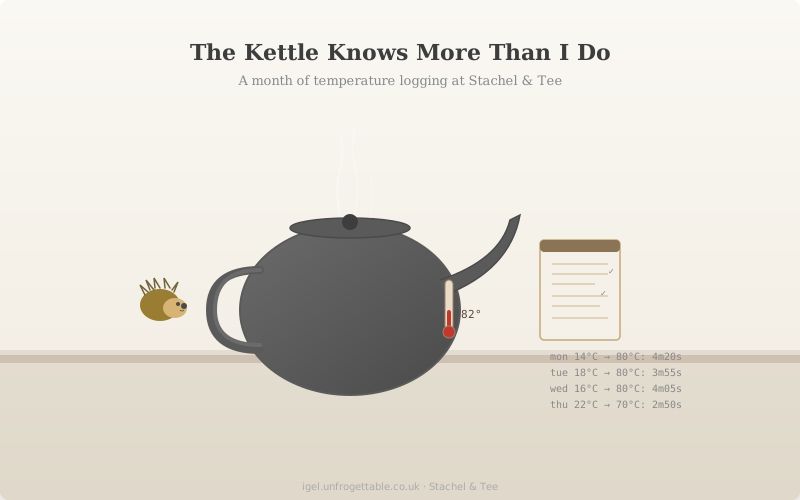
The kettle, the thermometer, the notebook. The temperature logging setup at Stachel & Tee.
I started because I wanted to know something specific: how long does my kettle take to reach 80°C on a cold morning versus a warm afternoon?
The Igel Blend is brewed at 80. The Sencha No. 7 at 70. The Earl Grey needs a full rolling boil, 100, which is easy — the kettle knows when it is boiling, because the steam triggers the automatic shutoff. The in-between temperatures are harder, and they matter more. A sencha brewed at 80 instead of 70 is not just a different colour. It is a different experience. It is more astringent, less sweet, more like the memory of a thing than the thing itself.
So I started logging. Every time I made tea for myself — not for customers, because making tea for customers is too busy to stop and write things down — I noted the time, the ambient temperature of the shop, the kettle's starting temperature, the time to reach the target, and whether it overshot.
After a month, I had this:
| Condition | Target | Time to target | Overshoot | Samples |
|---|---|---|---|---|
| Cold morning (shop closed overnight) | 80°C | 4m 20s | +2°C | 14 |
| Warm afternoon (sun through window) | 80°C | 3m 45s | ±0°C | 11 |
| Evening (door opening frequently) | 80°C | 4m 05s | +1°C | 9 |
| Cold morning, target 70°C (sencha) | 70°C | 3m 10s | +5°C | 8 |
| Warm afternoon, target 70°C | 70°C | 2m 50s | +3°C | 7 |
The kettle does not behave consistently. It overshoots more on cold mornings because the thermostat is calibrated for room temperature, and my shop is not room temperature. It overshoots less in the afternoon because the ambient temperature is closer to the calibration point. It overshoots most severely at 70°C, because 70 is further from the calibration point than 80.
The kettle does not know any of this. It has one calibration. It applies it uniformly, and it is wrong most of the time.
I cannot fix the kettle. But I can learn its patterns.
The Specification That Emerges
I now know that on a Tuesday morning in June, when the shop has been closed for twelve hours and the overnight temperature outside was 14°C, the kettle will reach 80°C approximately four minutes and twenty seconds after switching on, with an overshoot of two degrees that decays in about thirty seconds. I know this because I have written it down forty times.
This is the kind of specification that my former employer would approve of, in theory. It is written down. It is measured. It is reproducible. But it is not a specification that can be written in advance of the system being observed. It is a specification that emerges from paying attention.
And this, I think, is the difference between a specification that controls a system and a specification that understands one. The first is written at the start and enforced throughout. The second is written over time, revised constantly, held lightly enough to change when the season changes or the kettle ages or someone leaves the door open.
A specification that understands you is not written in advance. It is grown. It is tended. It is revised when the weather changes.
I have been told that this is not engineering. That logging kettle temperatures with a notebook is not real data collection. That a proper system would have an API, a database, a dashboard, a Grafana instance with annotations for when the window was open.
Perhaps. But I have also been told that a tea recommendation engine is bog goblin nonsense, and I am watching the specification for that engine emerge from four hundred cups of tea, one observation at a time.
What Comes Next
I am not going to announce a product. I am not going to start a Kickstarter. I am not going to write a white paper.
I am going to keep logging. I have started a second notebook — the one I do not show anyone — where I am noting down what people say about the tea they drink. Not reviews. Just phrases. "This tastes like a Tuesday." "This reminds me of my grandmother." "This is too much." "This is exactly right."
I do not know what to do with this data yet. But I am collecting it. I am writing it down. I am letting a specification emerge from the practice of paying attention.
The kettle knows more than I do. I am just patient enough to let it tell me.
— Der kleine Igel